| Finite
Geometry Notes |
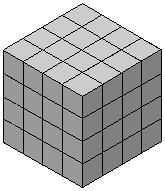
For some of the simpler substructures of the
4x4x4 cube, see
Geometry of the 2x2 Square, These traditional and supposedly
well-known structures are, surprisingly, closely related to
small finite
geometries.
These finite geometries underlie some
remarkable symmetries of
graphic
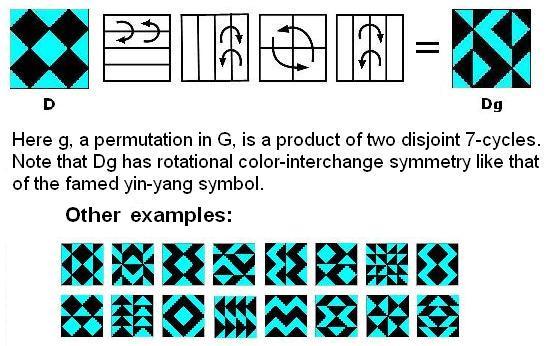
designs. For instance, there is a group G of 322,560
natural transformations which, acting on the four-diamond figure D
below, always yields a symmetric
image. This group turns out to also be
the automorphism group of the 16-point four-dimensional finite affine
space.
![]() For an animated illustration, click here. Such designs are formed by assembling
two-colored square tiles or
two-colored cubical blocks
into larger squares or cubes, when the number of tiles or blocks in the
larger arrays is a
power of two.
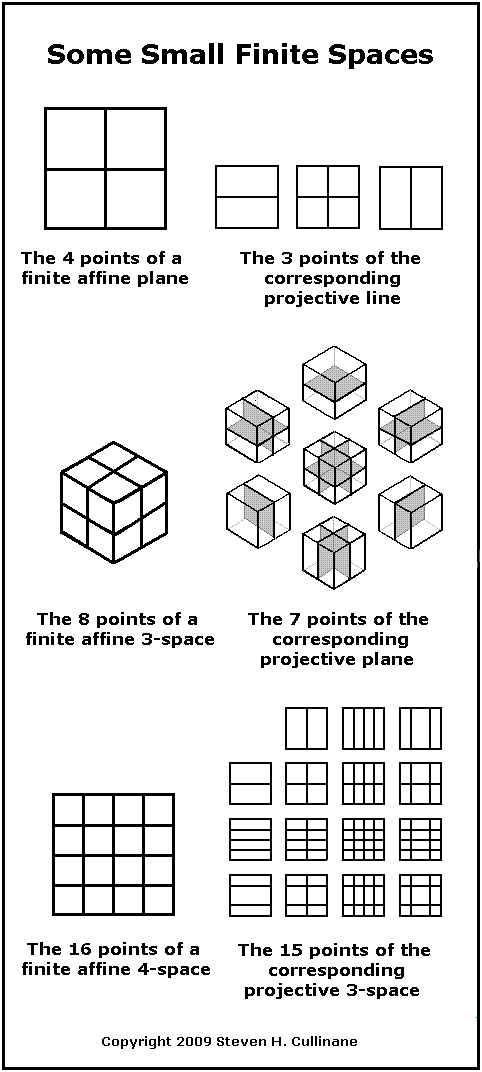
The structure underlying such graphic
symmetries is that of finite
projective geometry:
![]() Similar structural diagrams can be made for the 64 and 63 points of, respectively, finite affine and projective spaces of 6 and 5 dimensions over the 2-element field, and the graphic symmetries that result generalize the results in fewer dimensions. For a more detailed example of how affine and
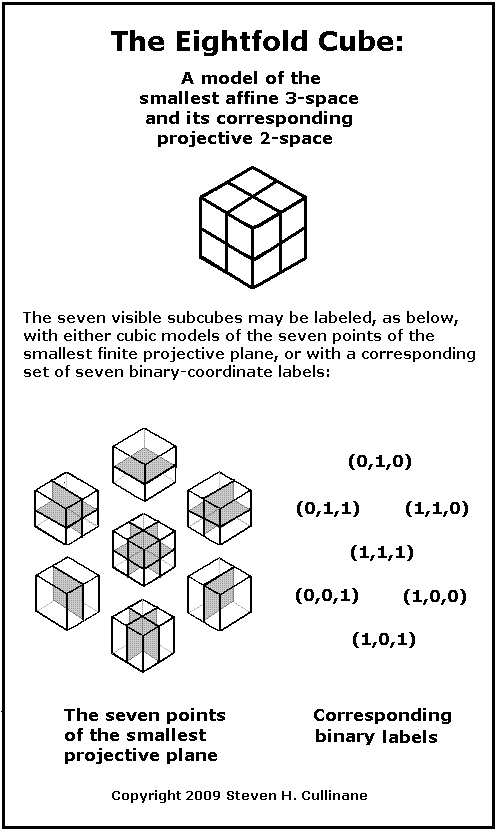
projective points are
related in such models, click on the image below.
![]() An earlier presentation
of the above seven partitions of the eightfold cube:
When the number of tiles or blocks in a square or cubical array is a power of an odd prime, symmetry of a different sort results. In the power-of-two case, despite the designs' overall symmetry, the natural permutations interchanging tiles or blocks are generally asymmetric. In the odd-prime case, there is no natural way to form symmetric graphic designs, but, on the other hand, the natural permutations of tiles or blocks are themselves always symmetric. For the simplest example of the odd-prime case, see Geometry of the 3x3 Square. For a more detailed look at these topics, see Notes on Finite Geometry (the detailed site map for this website). |
|||||